The Dungeon Master's Guide to Enterprise Application Design
Building systems that balance structure and freedom, where users engage rather than comply.
My family enjoys watching Dimension 20 and Critical Role, and I’ve come to appreciate how a good Dungeon Master makes a story come alive. It got me thinking about parallels in enterprise application design. Too often, our systems act like bad campaigns: rigid, over-scripted, and disengaging. When we design them more like a well-run game—with structure that supports creativity—users become players in a shared story rather than subjects of a process.
When work feels like a bad campaign
Anyone who has played a tabletop role-playing game knows the difference between a great campaign and a miserable one. A good Dungeon Master (DM) gives players a world rich in possibility, clear rules, and space for creativity. A bad one drowns everyone in dice rolls, rulebooks, and arbitrary decisions until it’s the joy that has been vanquished.
Many business applications feel like the latter. Every field is required, every workflow rigid, every deviation punished. Users become reluctant participants in someone else’s rule set instead of motivated actors pursuing a shared goal.
But enterprise systems do not have to feel like bureaucracy. The best of them work like great campaigns: structured enough to be fair, flexible enough to invite play, and guided by a world-builder who knows when to enforce rules and invite creativity.
The Dungeon Master’s role in the enterprise
A DM defines the physics of a fictional world. They set boundaries, arbitrate fairness, and keep the narrative moving. That is remarkably similar to what a system architect, process designer, or platform administrator does in the digital world.
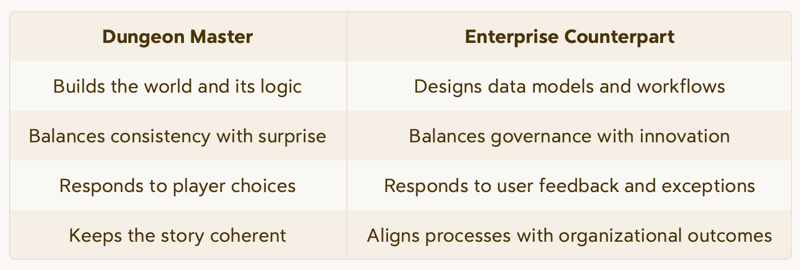
Both roles demand judgment: too little structure and chaos reigns; too much, and both players and users disengage.
Principle 1: Clear rules, flexible interpretation
In Dungeons & Dragons, the rulebook is non-negotiable, but interpretation is everything. A creative DM uses rules to frame imagination, not kill it. They remind players what is possible, then reward inventive solutions that stay within the spirit of the game.
Business systems should do the same. Make the boundaries explicit—validations, compliance, data integrity. Then allow room for discretion through conditional logic, optional fields, user-editable templates, and adjustable thresholds. Rules should enable fairness and trust, not micromanage judgment.
Principle 2: Agency within the world
Players stay engaged because their choices matter. They can decide whether to sneak past the dragon or negotiate with it, and every outcome changes the story.
Enterprise applications rarely give that feeling. Most reduce users to form-fillers. Yet even small design decisions can restore a sense of authorship:
-
Let users define personal dashboards or filters.
-
Allow multiple valid process paths for the same outcome.
-
Expose parameters they can tune without calling IT.
-
Allow users to claim ownership of records (I’ve got this, I’m working on this) so accountability feels chosen, not assigned.
When users feel they are playing the game rather than feeding the system, data quality and engagement rise naturally.
Principle 3: Shared narrative and purpose
Every campaign has a story: rescue the village, find the artifact, defeat the lich. Players understand why their actions matter.
In business systems, that narrative often disappears under a stack of forms. Bring it back by displaying relevant metrics, customer outcomes, or downstream impacts alongside tasks. Show how each approval, case resolution, or report ties to the mission. Autonomy without purpose is chaos; purpose without autonomy is drudgery.
Principle 4: Collaborative roles
A party succeeds because each class contributes differently: fighters hold the line, clerics heal, rogues improvise. The fun lies in interdependent autonomy—freedom within coordinated roles. Design systems the same way:
-
Role-based permissions that empower rather than restrict.
-
Cross-functional visibility so one team can see the state of another without needing full control.
-
Handoffs that feel like cooperation, not bureaucracy.
The more complementary the roles, the more cohesive the adventure.
Principle 5: Adaptive challenge
A good DM adjusts difficulty as players grow. Too easy and the party coasts; too hard and they quit. That is exactly the balance between automation and discretion in enterprise software.
Early users need guidance, guardrails, and defaults. As they gain expertise, expose configuration options, shortcuts, and advanced modes. Link permission levels to demonstrated competence. Mature teams should feel trusted, not babysat.
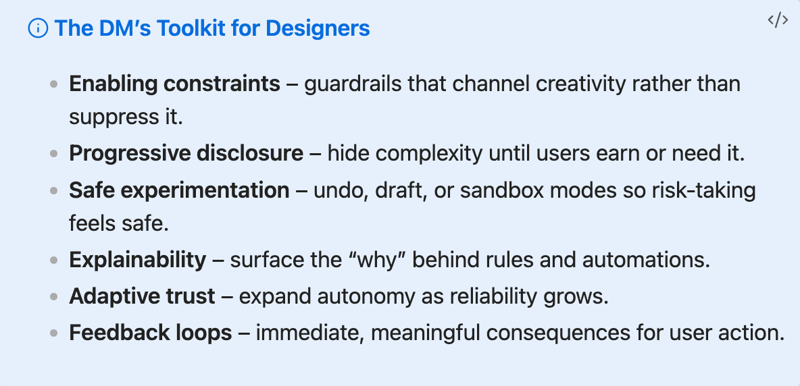
These are the design equivalents of dice rolls, experience points, and leveling up: mechanics that make engagement sustainable.
When the game goes wrong
Bad campaigns, and bad applications, share predictable flaws:
-
Over-scripted worlds where every action is pre-approved; players disengage or hack the system.
-
Under-governed chaos with inconsistent rules, duplicated data, and “homebrew” processes everywhere.
-
No narrative coherence, so people optimize for forms rather than outcomes.
-
No feedback, leaving users unsure whether they succeeded, failed, or just filled another form.
Fixing these problems is not about more features; it is about restoring balance between control and agency.
Governance as storytelling
In D&D, the DM does not play against the party; they play with them. Their job is to keep the story moving, not to win. Governance should do the same: create the conditions for good decisions so the story can unfold.
Good governance is transparent; users know what can and cannot be changed, and why. It is responsive; exceptions are treated as learning opportunities, not infractions. And it is iterative; the world evolves with player feedback.
Think of your administrative dashboards and rule frameworks as your Dungeon Master’s screen—tools that help you orchestrate fairness, continuity, and surprise without breaking immersion.
The endgame: designing for agency
The enduring lesson from tabletop gaming is that rules and freedom are not opposing forces. Rules make freedom meaningful. Within that structure, players find agency, creativity, and flow.
Enterprise application designers face the same challenge: build worlds that are safe, coherent, and accountable, yet alive enough for users to make them their own.
When you next design a workflow, ask yourself: Is this a roll of the dice that builds anticipation and energy, or just another locked door in a corridor of compliance?
In both games and work, people thrive not when they are controlled, but when they feel trusted to play well inside a well-crafted world.
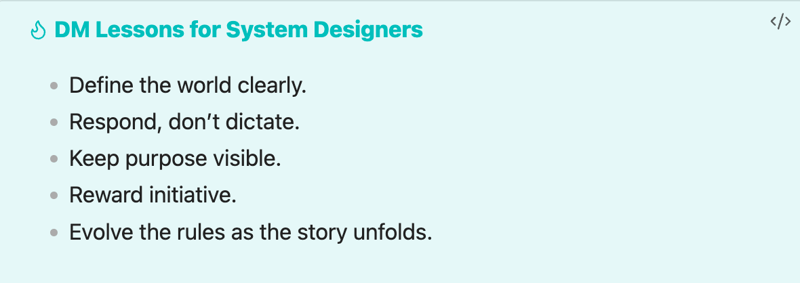
If you design or manage business applications, try thinking like a Dungeon Master: set the boundaries, make the rules clear, and then let people play. The goal isn’t control; it’s to create the conditions for good decisions and meaningful engagement.